
Boosting Productivity with ADHD: Effective Strategies for Focus
ADHD, or Attention-Deficit/Hyperactivity Disorder, impacts millions of people worldwide, often making feeling productive at work or at home a daunting challenge.
Time management with ADHD works best when it’s built around the brain you actually have, not the one a planner app assumes you do. The most useful approach combines visible time, smaller task steps, fewer priorities, environmental supports, and realistic recovery time. These ADHD productivity tips are practical, flexible, and meant to reduce shame while making daily work easier to start, track, and finish.
I’m Emma, an Accredited Social Worker who supports young people with ADHD. I’m sharing tips you can implement right now, whether you're navigating ADHD symptoms in your personal life or simply looking for more tools and strategies to help you harness your unique strengths.
When you’re ready to move beyond just tools and strategies and get mental health support for your ADHD, I’m currently accepting new clients. Book your free consultation here.
Let’s explore practical, science-backed approaches to boost productivity while helping you manage your ADHD effectively.

Why does ADHD make time management so difficult?
ADHD can affect attention, impulsivity, planning, follow-through, and emotional regulation, which means “just make a schedule” often doesn’t address the real problem. Many folks with ADHD experience time blindness: the sense that time is either “now” or “not now,” making it hard to estimate how long tasks will take or notice when a deadline is approaching.
Adult ADHD treatment may include medication, therapy, behavioral strategies, or a combination, and practical tools often work best when they are part of a broader support plan.
That is why effective ADHD time management is less about willpower and more about externalizing executive function. Instead of holding a plan in your head, you put it where you can see it. Instead of relying on motivation to appear, you create cues, rewards, and friction-free starting points.
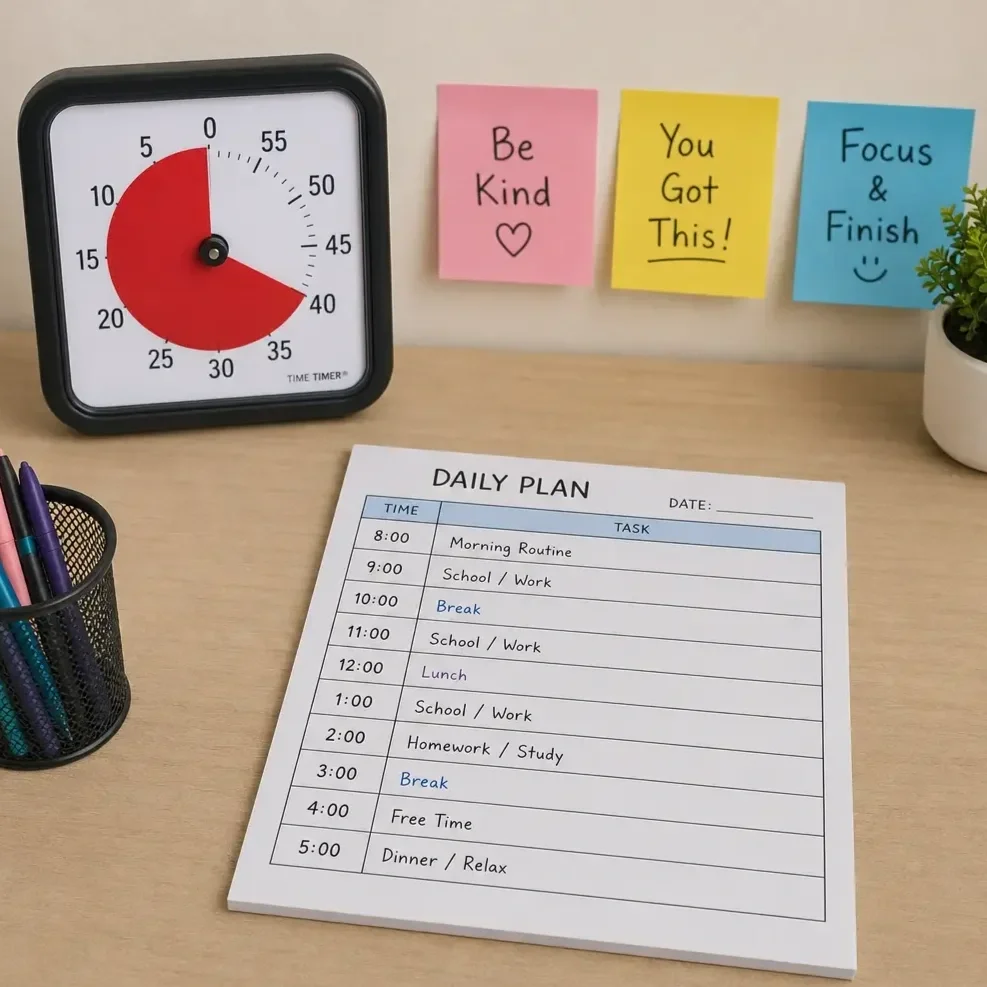
Make time visible before you try to manage it
Make time physical, visual, and hard to ignore. A digital calendar is helpful, but many people with ADHD need something more immediate than a hidden notification. Try a visual timer, an analog clock, a whiteboard schedule, or a sticky note timeline for the next few hours.
Find the Visual Clock I like from Amazon
A simple “time map” can be more useful than a perfect calendar. Write down what is already fixed, then place tasks around those anchors with buffers. Think about the transition time you might need between activities (and yes, be realistic with yourself!).
Try this daily time check:
List fixed commitments first. Meetings, appointments, school pickup, meals, commute time, and sleep go on the page before tasks.
Add transition space/recharging space. Put 10 to 30 minutes between demanding activities when possible.
Choose work blocks, not a giant to-do list. Assign one clear focus to each block.
Use alarms for starts and stops. A reminder to begin is just as important as a deadline reminder.
Review at midday. Adjust the plan before the day runs away from you.
This is one of the most important ADHD management strategies because it reduces the mental effort of constantly deciding what comes next.
Use smaller work intervals than traditional productivity advice suggests
The classic Pomodoro method uses focused work periods followed by short breaks, but ADHD brains often need customization. If 25 minutes feels too long, start with 10. If you finally get into flow and stopping breaks momentum, use a longer work sprint and schedule a more obvious recovery break afterward.
The goal is not to obey a timer. The goal is to create a start line, a finish line, and a reason to return. For boring, vague, or emotionally loaded tasks, even a five-minute “activation sprint” can help. You are not promising to finish the whole report, clean the whole room, or answer every email. You’re promising to start.
Helpful work interval options include:
5 minutes: for avoidance, overwhelm, or task initiation.
10 to 15 minutes: for chores, email sorting, admin, or reading.
25 minutes: for focused desk work when you have enough energy.
45 to 60 minutes: for deep work if you tend to need longer warm-up time.
Body-doubling sessions: for tasks that become easier when another person is quietly present.
These ADHD strategies work because they lower the emotional cost of starting. Once a task is in motion, continuing often becomes easier.
Prioritize fewer tasks and define “done” clearly
A long to-do list can create the illusion of control while quietly increasing paralysis. For ADHD, prioritisation needs to be visible and limited. Instead of asking, “What should I do today?” ask, “What are the three outcomes that would make today successful?”
Choose no more than three high-priority tasks for the day. Then break each one into a concrete next action. “Work on taxes” is vague. “Download bank statements” is doable. “Clean kitchen” is broad. “Load dishwasher and clear counters” gives your brain a finish line.
Use this quick sorting method:
Must do: deadline-driven, high-consequence, or time-sensitive.
Should do: useful, but movable if the day changes.
Could do: bonus tasks for extra capacity.
Not today: tasks that are real, but not allowed to steal attention right now.
This approach supports how to manage ADHD without pretending every task has equal weight. It also prevents low-urgency tasks from crowding out the work that will reduce stress later.
How can you reduce distractions without relying on self-control?
The most reliable way to manage distractions is to change the environment before you need focus. Self-control is harder when the phone is beside you, the browser has 19 tabs open, and your workspace is full of unfinished visual reminders. CHADD notes that adults with ADHD can struggle with clutter and may benefit from practical organizing supports, including help from a coach, organizer, or therapist when needed. (chadd.org)
Start by identifying your personal distraction pattern. Some people lose time to social apps. Others drift into email, snacks, side quests, cleaning, or research rabbit holes. Once you know your pattern, build a barrier.
Try these environmental ADHD coping strategies:
Put your phone in another room during focus blocks.
Use website blockers for your most tempting sites.
Keep only the materials for the current task on your desk.
Use noise-cancelling headphones, brown noise, or instrumental music.
Have a notepad beside you to create a “later list” for unrelated ideas that pop up while working.
Close loops visually: use only one notebook, one task board, one calendar.
The key is to make distraction slightly harder and the intended task slightly easier. You don’t need a perfect workspace. You just need fewer open doors for your attention to wander through.
Build routines that cue the brain to start and stop
Routines help because they reduce negotiation. When the same small sequence happens before work, your brain starts to recognize your pattern: this is where we begin. A routine doesn’t have to be long, aesthetic, or impressive. It just has to be repeatable.
A morning start-up ritual might look like:
Fill water or coffee.
Open the same planner, app, or notebook.
Review today’s fixed commitments.
Pick the first task only.
Set a timer for a short activation sprint.
A shutdown ritual is just as useful. At the end of the workday, write down what is unfinished, choose the first step for tomorrow, close tabs, and reset your workspace for the next start. This prevents your brain from carrying every loose end into the evening.
Routines can be especially helpful when learning how to deal with ADHD in daily life because they reduce the number of decisions required. Fewer decisions mean less friction, less avoidance, less paralysis, and more usable energy.
Use technology carefully, not constantly
Apps can help, but app overload can become another form of procrastination. The best tool is the one you’ll actually open when you are tired, late, bored, or overwhelmed. If a system requires constant maintenance, color coding, tagging, and weekly rebuilding, it may be too much for everyday use.
Pick one main place for tasks and one main place for appointments. For example, you might use a calendar for time-specific commitments and a simple task board for everything else. Sticky notes, Trello, Notion, Todoist, paper planners, and whiteboards can all work if the system stays visible and easy to update.
Before adding a new tool, ask:
Does this reduce steps or add steps?
Will I see it at the moment I need it?
Can I recover quickly if I stop using it for a week?
Does it help me act, or does it invite me to reorganise endlessly?
Remember, good ADHD time management tools should support action!
Motivation improves when the reward is closer
ADHD can make distant rewards feel unreal. A deadline next month might create enough urgency today, even when the task matters. That doesn’t mean you’re lazy. It means your system needs shorter feedback loops.
Bring the reward closer by pairing effort with something immediately satisfying. Work with a friend on video. Check off a visible box. Play a favorite playlist only during admin tasks. Give yourself a short walk after a focus block. Start with an easy win when you feel frozen, because progress often creates more progress.
It also helps to connect tasks to a clear “why.” Not a dramatic life purpose every time, but a practical reason: “I am answering these emails so tomorrow morning is calmer,” or “I am packing tonight so I do not start the day in panic.”
Support is part of the system
Some ADHD challenges need more than hacks. Therapy, coaching, medication discussions, workplace accommodations, sleep support, and treatment for anxiety or depression can all be part of a realistic plan. NIMH describes psychotherapy, including cognitive behavioral therapy, and medication as common treatment options for adults with ADHD, while emphasizing that care should be individualized with a qualified professional. (nimh.nih.gov)
This matters because productivity is not separate from emotional regulation. Shame, burnout, rejection sensitivity, and repeated “failed” systems can make planning feel threatening. Good support helps you notice patterns without turning them into character flaws.
If ADHD is interfering with your work, school, relationships, finances, or daily functioning, consider talking with a licensed mental health clinician. Practical strategies are powerful, but they are not a substitute for diagnosis or therapeutic intervention.
A simple ADHD-friendly daily plan
Here is a realistic template you can adapt:
Morning: check calendar, choose three priorities, start with a 10-minute activation sprint.
Midday: review what changed, move one task if needed, eat, hydrate, and reset your workspace.
Afternoon: use one protected focus block for the most important remaining task.
Evening: write tomorrow’s first step, prepare visible cues, and stop planning.
The best ADHD strategies are the ones you can return to after a messy day. And remember, you’re not trying to build a flawless routine; you’re building a system that can bend and flex around your brain when you need it to.
The takeaway
Managing time with ADHD isn’t about forcing yourself into a rigid productivity mold. It is about making time visible, reducing choices, shrinking task starts, protecting attention, and using support without shame. Start with one technique from this list, test it for a week, and adjust it to fit your real life. Small systems that you can actually use will beat perfect plans every time.
About the Author
Emma is an Accredited Mental Health Social Worker high-achieving young people with ADHD to manage their overwhelm and build confidence that doesn’t depend on their last result. She is the founder of Ryse Wellbeing, a mental health service based in Melbourne, specialising in the mental health, neurodiversity, and wellbeing of athletes.