
Counsellors, Social Workers, or Psychologists in Australia: Who to See
So you’ve decided to see a therapist. But after hours of Google searches, you’re left confused and frustrated.
Who should I see? A counsellor? A social worker? A psychologist?

With so many titles and overlapping roles, it can be overwhelming to understand who does what—and which option might be right for you or your family.
Hi, I'm Emma (An Accredited Social Worker), and I’m happy to break down the different roles so they make sense!
Whether you’re seeking support for anxiety, depression, ADHD, trauma, relationship challenges, or something else entirely, this guide will help you feel more confident in finding the right fit.
Counsellors: Supportive Conversations for Life’s Challenges
Counsellors work with individuals, couples, and families to help them navigate everyday stress, emotional struggles, grief, and life transitions. They typically offer talk therapy in a supportive environment, helping clients build coping skills, reflect on patterns, and explore solutions.
Education & Training:
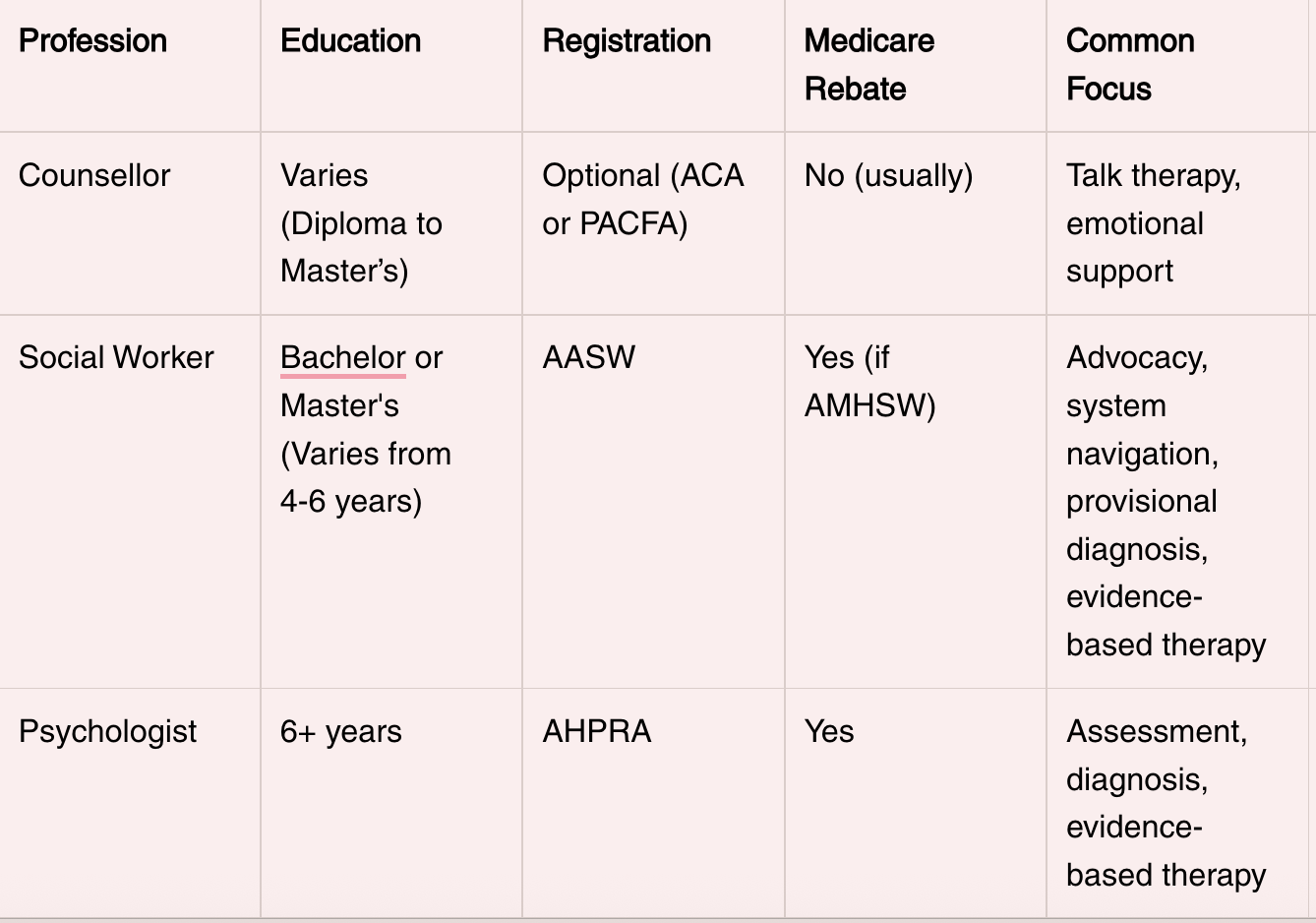
Counselling is not regulated in Australia, meaning training pathways can vary. Some counsellors have a diploma or bachelor’s degree, while others have completed a master’s in counselling or psychotherapy. Many are members of professional associations like the Australian Counselling Association (ACA) or the Psychotherapy and Counselling Federation of Australia (PACFA), which set ethical and training standards.
Access & Cost:
Counsellors often work in private practice, schools, community organisations, and EAP (Employee Assistance Program) settings. They are generally more affordable than psychologists, but they are not eligible for Medicare rebates unless they hold other qualifications (like social work or psychology).
When to See a Counsellor:
If you’re looking for emotional support, want to explore your thoughts and feelings, or need help navigating a difficult time, a counsellor can be a great place to start.
Social Workers: Mental Health and Practical Support
Social workers are trained to see the bigger picture. We’re not just focused on the individual; we also look at how family, community, systems, and broader social issues impact your well-being. Some social workers provide therapy and work in mental health services, while others support people to access housing, family violence, financial assistance, or other services.
Education & Registration:
To become a social worker in Australia, you need a Bachelor of Social Work (usually 4 years) or a Master of Social Work. Those who want to offer therapeutic services may become an Accredited Mental Health Social Worker (AMHSW) through the Australian Association of Social Workers (AASW).
What’s an AMHSW?
AMHSWs are specially trained to provide therapy, have a strong background in mental health treatment, and have met additional hours of clinical supervision. AMHSW’s can conduct a social work assessment, provide a provisional diagnosis*, create a treatment plan, and provide therapy. They are recognised by Medicare, which means you can access rebates with a referral from your GP under a Mental Health Care Plan.
Do social workers need to be AMHSW to provide therapy?
No, social workers don’t need to be qualified as AMHSWs to provide therapy or counselling support. The only drawback is that without this credential, you can’t access Medicare rebates.
Scope of Practice:
Social workers support people experiencing mental health challenges, trauma, family violence, grief, and more. We incorporate focused psychological strategies and evidence-based therapies (like CBT, ACT, and DBT) to support our practice. We also help people navigate complex systems like NDIS, Centrelink, and child protection.
When to See a Social Worker:
If you’re looking for support that includes both therapy and practical help, especially if systems or life circumstances are affecting your mental health—a social worker could be the right fit.
*A provisional diagnosis is an initial or working diagnosis that a mental health professional makes based on the information available at the time. It’s not a final or confirmed diagnosis—it helps guide early treatment or further assessment while more information is gathered.
Psychologists: Mental Health, Behaviour, and Assessment
Psychologists are trained to understand human behaviour, mental processes, and emotional functioning. They provide evidence-based therapies (like CBT, ACT, and DBT), conduct psychological assessments, and help people manage mental health conditions like depression, anxiety, trauma, and more.
Education & Regulation:
Psychologists must complete at least six years of university training (often more) and be registered with the Australian Health Practitioner Regulation Agency (AHPRA). Some go on to complete specialist training to become clinical psychologists, which allows them to provide diagnoses and specialised treatment.
Access & Cost:
You can see a psychologist through private practice, public health services, or with a GP referral under a Mental Health Care Plan, which makes you eligible for Medicare rebates (rebate amounts vary depending on whether they’re a general or clinical psychologist).
When to See a Psychologist:
If you’re seeking evidence-based therapy, want a diagnosis, or need formal assessments (e.g. for ADHD, learning difficulties, etc.), a psychologist may be the best option.
A Quick Comparison:
So, Who Should You See?
You might hate my answer here, but it depends. Ultimately, it depends on your goals, needs, and the support you’re looking for.
•Want someone to talk to during a tough time? A counsellor might be a good start.
•Looking for treatment of a mental health condition or system-related challenge with a holistic and systems-informed lens that? A social worker could be ideal.
•Need a diagnosis or structured treatment for a mental health condition? A psychologist might be the right fit.
All of these professionals can offer meaningful support, and they can refer to the most appropriate provider for your needs. If they’re not the right fit, you don’t need to have it all figured out before you reach out.
Final Thoughts and FAQ’s
It’s already such a big step to say you’re ready for help, and searching for the right therapist can feel like a second job. If you’re not sure who to contact first, it’s okay to reach out and ask questions—many practitioners offer free consultation calls or meet-and-greets to help you find a good fit.
As a social worker myself, I work most often with teenagers, young adults, and their families who are navigating mental health challenges from anxiety to ADHD to self-harm to relationship challenges. If you’re curious about what therapy with a social worker looks like, check out my approach to therapy or book a free consultation to see if I'm the right fit for you.
Q&A
Can I get Medicare rebates for counselling, social work, or psychology sessions?
Short answer: Medicare rebates are usually available for psychologists and Accredited Mental Health Social Workers when you have a GP referral and a Mental Health Care Plan. Counsellors are usually not eligible for Medicare rebates unless they also hold another eligible credential, such as social work or psychology.
Do I need to know exactly which professional is right before I reach out?
Short answer: No. You don’t need to have it all figured out first. Many practitioners offer free consult calls or meet-and-greets, and if they are not the right fit, they can often refer you to someone who is!
What is the main difference between seeing a social worker and seeing a psychologist?
Short answer: Both can offer evidence-based therapy, but they often use different lenses. Social workers often combine mental health treatment with practical and systems-based support, such as help with linking with schools, NDIS, Centrelink, child protection, housing, or family violence. Psychologists are often the best fit when you need structured mental health treatment, diagnosis, or formal assessments, such as for ADHD or learning difficulties.
Does a social worker have to be an AMHSW to provide therapy?
Short answer: No. Social workers do not need to be Accredited Mental Health Social Workers to provide therapy or counselling support. But without the AMHSW credential, clients usually cannot access Medicare or private health rebates for those sessions.
Who might be the best starting point if I want emotional support during a difficult time?
Short answer: A counsellor may be a good first step if you want supportive conversations, space to explore your thoughts and feelings, and help building coping skills. If mental health conditions, complex life stress, system-related challenges, diagnosis, or formal assessment are part of the picture, a social worker or psychologist may be a better fit.
References:
Australian Counselling Association (ACA):https://www.theaca.net.au/
Psychotherapy and Counselling Federation of Australia (PACFA):https://www.pacfa.org.au/
Australian Association of Social Workers (AASW):https://www.aasw.asn.au/
Services Australia – Mental Health Treatment Plans:https://www.servicesaustralia.gov.au/mental-health-care-and-medicare
Australian Psychological Society (APS):https://psychology.org.au/
Australian Health Practitioner Regulation Agency (AHPRA):https://www.ahpra.gov.au/
Department of Health – Better Access Initiative:https://www.health.gov.au/our-work/better-access-initiative