
Quick answer (TL;DR): To find the right mental health provider in Melbourne, get clear on what you want help with, shortlist a few social workers/psychologists/occupational therapists, check their credentials and approach, then book an initial consult to see if it feels like a good fit. If it doesn’t, it’s okay to try someone else.
If you need urgent mental health support: If you’re in immediate danger or at risk of harm, call 000. In Australia, you can also contact Lifeline (13 11 14), Beyond Blue (1300 22 4636), or Suicide Call Back Service (1300 659 467).
Step-by-step: What to do beyond googling “psychologist near me” in Melbourne
Identify what’s going on. For example: anxiety, burnout, grief, trauma, relationship stress, parenting support, ADHD assessment, etc.
Decide what kind of support you want. In-person in Melbourne, online/telehealth, individual sessions, couples therapy, group programs.
Pick the right provider type (see the table below). Want to know more about different providers and how they can help? Check out Choosing Between Providers for a more in-depth picture of who accepts Medicare rebates and who can help based on what’s going on.
Check costs and rebates. Ask about fees, Medicare rebates (if relevant), private health, and concession options.
Shortlist 3–5 options. Look for experience with your concerns, a therapy approach you’re open to, and availability that suits your schedule.
Do a quick credibility check. Look for AHPRA registration (for psychologists/psychiatrists) and membership info where applicable.
Book an initial consult. Use it to see how you feel talking with them, not just to “start therapy properly”.
Review after 2–3 sessions. You should feel respected, heard, and like there’s a plan. If not, switch.
Which mental health provider should you see?
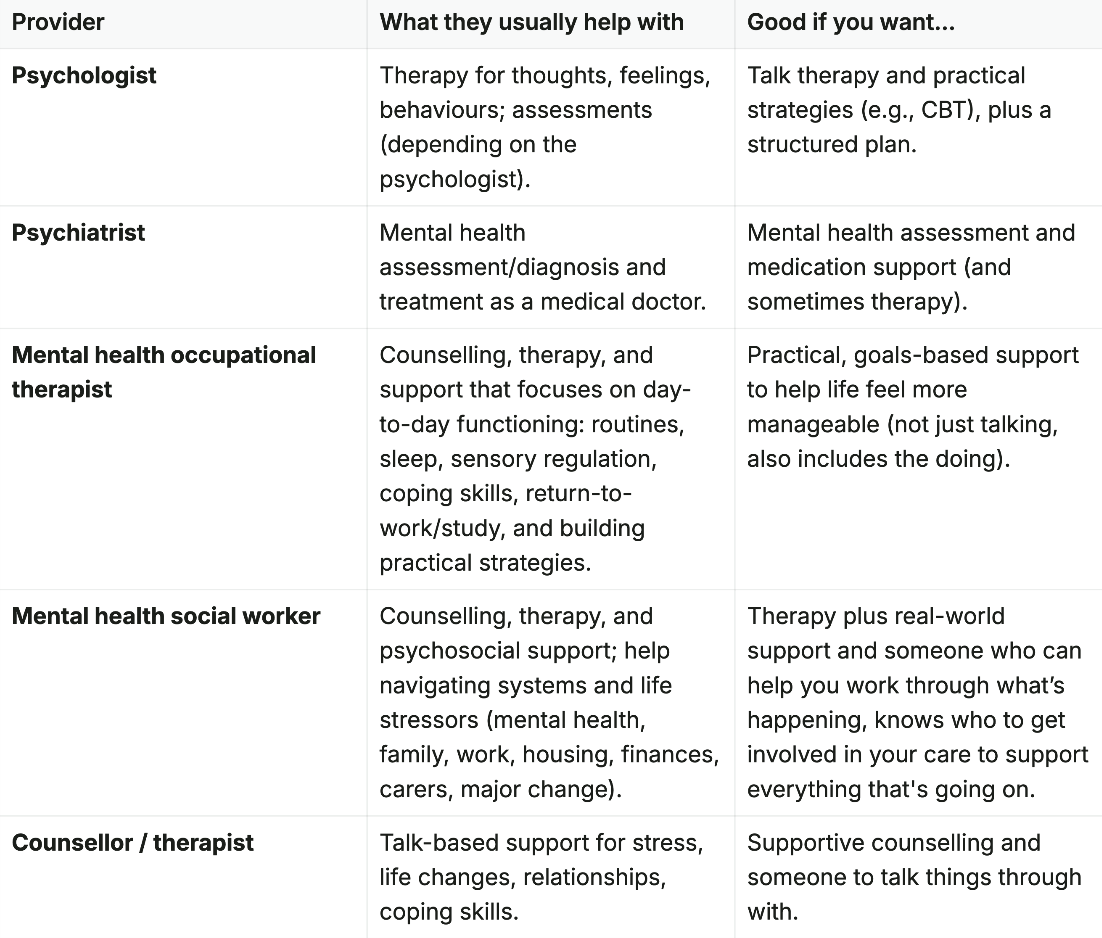
Table describing the difference in mental health providers in Australia
Not sure? A GP can be a good first stop. They can help you figure out next steps and (if appropriate) provide a Mental Health Treatment Plan so that some sessions can receive Medicare rebates.
What to look for (so you’re not guessing)
Experience with your concern: e.g., panic, trauma, perinatal mental health, neurodiversity, workplace stress, etc.
Approach that suits you: CBT, ACT, schema therapy, EMDR, mindfulness-based work (you don’t need to know all the acronyms, just ask what it’s like in practice).
Logistics that won’t burn you out: location, parking/PT, telehealth, session times, cancellation policy.
Comfort: you can be honest with them, and they make you feel comfortable.
How to research local psychologists, social workers, and occupational therapists (without falling down a rabbit hole)
Use online directories
Directories can help you filter by location, specialty, and availability. Try:
Check community recommendations
Local community centres, support groups, and Melbourne-based or suburb-based forums can be useful for general direction (just remember that what works for someone else might not be your best match).
Questions to ask before you book
Have you worked with people dealing with [your issue]?
What’s your approach, and what does a typical session look like?
How do you set goals and track progress?
What are your fees, and are rebates available?
What’s your availability like over the next few weeks?
What to expect in the first session
Most first sessions are a mix of getting to know you and working out a plan. You’ll usually cover what’s been happening, what you want to change, and any relevant history. You can also ask about confidentiality, notes, and how they handle risk/safety.
How to tell if it’s working
You feel listened to, not judged.
You understand what you’re working on (even if it’s hard).
You leave with at least one useful insight or next step.
The plan adjusts as your needs change.
FAQ (Melbourne)
How do I find a psychologist near me in Melbourne?
Search by [your suburb] therapy [your concern] ± [your age group].
Example: Williamstown therapy for ADHD teens.
You can use a directory to filter, then shortlist based on experience, approach, fees, and availability.
Do I need a referral to see a psychologist, social worker, or OT?
You can often self-refer, but if you want to access Medicare rebates, you’ll generally need a GP Mental Health Treatment Plan (check eligibility and current rules).
What’s the difference between a psychologist, psychiatrist, a mental health social worker, and a mental health OT?
Psychologists mainly provide therapy (and sometimes assessment). Psychiatrists are medical doctors who can do mental health assessment/diagnosis and prescribe medication (and may also provide therapy). Mental health social workers provide therapy plus support with real-life stressors and system navigation. Mental health occupational therapists provide therapy with a focus on practical skills and routines to help you function day-to-day.
How do I find someone who bulk bills or offers lower-cost sessions?
Ask clinics directly about bulk billing, sliding-scale fees, or concession rates. You can also ask your GP about options and local services. Availability varies, so it can take a few enquiries.
Is online therapy worth it?
For many people, yes. Especially if you want more flexibility or shorter wait times. If privacy at home is tricky, you can ask about phone sessions or find a private space (even sitting in your car if you need!).
What if I don’t click with the first therapist I try?
That’s common. If it doesn’t feel right after a couple of sessions, it’s okay to try someone else; you’re not being difficult, you’re doing what works.
Your therapist may be able to recommend someone who feels like a better fit!
Conclusion
Finding the right mental health provider in Melbourne can take a bit of time, but it’s absolutely doable. Start small, shortlist a few options, ask the direct questions, and choose the person who feels safe and practical to work with.