
When a Young Athlete Is Struggling: A Coach’s Guide to Performance & Athlete Mental Health
When an athlete is struggling, their coach is often one of the first people to notice. Whether there’s a shift in their performance, attitude, or overall mood, you’re often the first to pick it up through small noticings or through a gradual buildup over time.
Sport performance, well-being, and stress management will always be interconnected. However, when an athlete is struggling, it’s important to differentiate whether it’s a performance problem or a mental health-related challenge.
Is their confidence dropping in training, and the lack of confidence is carrying through to competitions and games? Likely, performance-related.
Or are you noticing increasing low mood or anxiety? Maybe they’re irritable, have sleep and appetite changes, and have lost interest in the sport they previously loved. Likely, mental health-related.
Now, you don’t have to diagnose, but it’s important to have the right tools to notice and respond when you’re concerned.
Hi, I’m Emma, an accredited social worker who supports young athletes through both learned and lived experience. This guide will cover what to look for, what to try, what to ask, and when to refer to a professional.

Step One: Is This a Sport Performance Issue?
Common Performance-Related Signs
Confidence drop after mistakes
Overthinking/freezing
Emotional spikes
Avoidance of key moments
Body language shifts
Increased self-criticism
Get Curious: Questions Coaches Can Ask
Was that a skill issue or a confidence moment?
On a scale of 1–10, how confident did you feel before that [action like a play/set/move]?
What helps you reset after mistakes?
What did you notice in your body before that [action like a play/set/move]?
When did you start feeling tense?
Where was your attention, on the task or the outcome?
What were you telling yourself just before the mistake?
Did that feel rushed or hesitant?
Are you worried about making mistakes, or something else?
What’s your reset cue?
What would staying present look like here?
If a teammate made that mistake, what would you tell them?
What helps you feel settled in training that we could bring into games?
What part of your performance are you proud of?
What Coaches Can Try First
Shift to controllables
Help your athlete to identify what they can control right now vs. what they don’t have control over (ie, control over their effort vs. the outcome).
Normalise mistakes
Validate their want to do things correctly, but that making mistakes is a very natural part of being an athlete and a human being.
Teach reset routines
Support them with strategies to reset after mistakes, especially if they’re prone to spiralling (ie. What self-talk will they use? How will they shift their attention back to what they’re doing)
Adjust feedback style
You might find that your feedback style needs to adjust based on the athlete you’re working with. You might notice some athletes prefer very direct feedback about what went wrong and what went right, and you may find some might need reflective questions (ie. How did that feel for you?) before going into adjustments or changes.
Reduce threat-based motivation
Threat -based motivation plays on our fight or flight systems to perform and isn’t an approach that will lead to long-term positive outcomes. When we rely on the fear system to perform, we’re relying on the athlete’s brain and body to feel unsafe. Over time, this can lead to mistrust, loss of enjoyment in sport, burnout, quitting the sport altogether, or a risk of traumatization.
Try shifting the focus to the WHY: why does the athlete want to perform a certain way, what does successfully performing look like to them?
Step Two: Could This Be Mental Health Related?
Signs It May Be More Than Performance
Changes beyond sport
Withdrawal from teammates
Persistent low mood
Irritability
Sleep/appetite/energy changes
Hopeless language
Perfectionism escalating
Increased substance use
Get Curious: Gentle Questions to Ask
How are things outside of your sport right now?
Have these challenges been showing up elsewhere?
What’s feeling hardest right now?
What support do you have?
What do you need from me?
Is there anyone I can help you talk to?
What Coaches Should Avoid
Dismissing emotions
Avoid statements like, “Oh everyone feels that way” or “Don’t worry about it, you’ll be fine”.
Validate emotions using statements like “I could see how you could feel this way with everything you have going on” or “It sounds like this has been really hard for you”
Over-diagnosing
You don’t need to know what diagnosis someone has or be able to identify it to support someone who’s struggling.
When you notice your brain shifting to diagnosing, take a step back and stay curious.
Public correction when vulnerable
Consider the level of vulnerability your athlete might be displaying, and whether public correction is most effective for their needs right now.
Using selection as emotional leverage
If your sport includes team selection, don’t use this as leverage to try to improve your athlete’s mood, nor to force mood improvement if they are chosen.
Forcing disclosure
Allow conversation to develop naturally. Checking in with your athletes is important, but don’t force the conversation into a direction they may not be ready for yet. Remember, to be vulnerable about how you feel can take time and courage.
When to Refer to a Professional
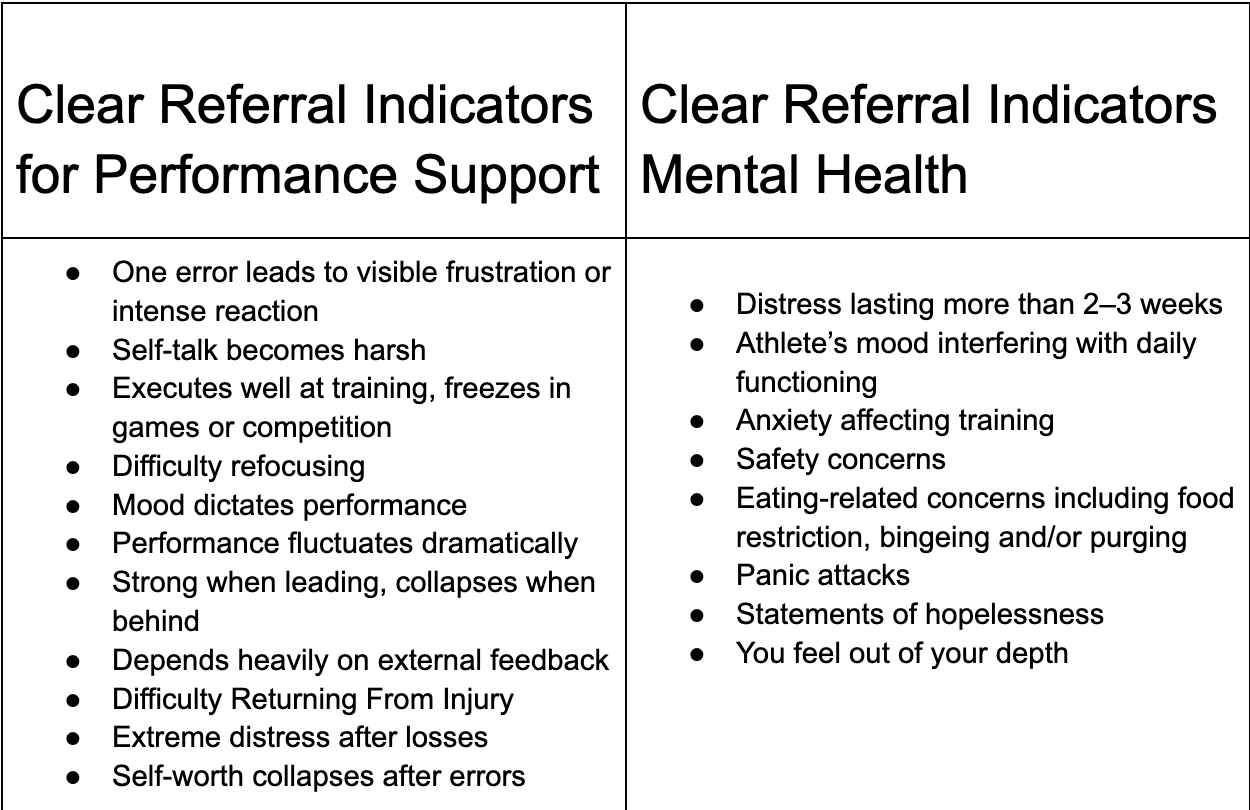
Urgent Athlete Mental Health Referral Situations
Risk of self-harm
If your athlete is having thoughts of or has engaged in self-harm, they should be referred to a mental health professional.
Self-harm includes hitting, cutting, or burning themselves, or any other purposeful self-inflicted injury.
Suicidal language
If your athlete expresses thoughts of suicide, they should be referred to a mental health professional.
If your athlete expresses a plan and/or intention to try suicide, or is unable to keep themselves safe, call 000 or support your athlete to attend the closest Emergency Department.
Severe behavioural changes
If you notice sudden changes in behaviour that are severe, such as rapid speech, bizarre or paranoid thinking, hallucinations, high-risk-taking behaviours, contact your local Mental Health Triage line, 000, or support your athlete to attend the closest Emergency Department.
How to Raise the Idea of Referral
Language examples coaches can use
Performance-related referral:
“I notice that you’re still struggling with [insert performance-related challenge here], and I want to help you. That’s why it would be helpful to speak with a professional who can support you to meet your performance goals. We can work together between the three of us to make a plan that’s implemented into training, and competition/games. I have some people that I can suggest, what do you think?”
“This feels less like a technical gap and more like a confidence-under-pressure piece. That’s something we can build with the right support. Would you be interested in exploring this together?”
Mental Health-related referral:
“I’m wondering if there’s more going on here. You don’t have to tell me everything, but I want to make sure you get the support you might need.”
“We’ve tried a few adjustments in training, and I’m still noticing this feels tough for you. That tells me it might help to bring in someone whose whole job is supporting athletes with this stuff. If you’d prefer, we can look at a few options together.”
Frame it as support, not punishment
Athletes may fear repercussions of seeking support for their mental health or performance, or they may have negative beliefs that something’s wrong with them. It’s important to validate those feelings and reassure them that you’re supporting them, and they’re not in trouble for sharing how they feel with you.
Involving parents appropriately (for youth athletes)
With athletes under the age of 18, encourage them to involve their parents in the process of seeking support.
Before even beginning a conversation with a young athlete, let them know that if they mention anything that leaves you concerned for their safety, you may need to let someone else know, and explore who another safe adult in their life might be.
You could offer to sit down with the athlete and their parents while they share how they’ve been feeling, and you could offer resources and referral options to the parent to support the process.
Staying in your lane while remaining supportive
Remember, it’s not your job to assess or diagnose an athlete’s mental health.
You can maintain your role as a coach that’s supportive and encouraging of your athletes seeking help when they need it.
What Coaches Should Avoid Saying
“You need therapy.”
“Something’s wrong.”
“This is becoming a problem.”
“You’re not coping.”
“Other athletes don’t struggle like this.”
“Get it together.”
Athlete Mental Health Resources to Share
Crisis Supports
Kids Helpline 1800 551 800
Headspace https://headspace.org.au/
Lifeline 13 11 14
Your Local Mental Health Triage
The Closest Emergency Department
000
If you’d like additional support
Supporting athletes under pressure is layered. Sometimes, small adjustments are enough. Sometimes structured performance support helps stabilise confidence and consistency. And sometimes what’s showing up in sports is connected to broader mental health.
At RYSE Wellbeing, we work alongside coaches, parents, and athletes to strengthen both performance and wellbeing, because how an athlete feels directly influences how they train, compete, and recover.
Support may focus on:
Confidence under pressure
Reseting after mistakes
Emotional regulation in competition
Managing performance anxiety
Navigating injury or selection stress
Reducing fear of failure
Identity outside of sport
Broader mental health concerns impacting performance
Our role is to strengthen the athlete’s internal skills, so they show up at their best
If you’d like to explore support for an individual athlete, your team, or your club, you can:
Sport-Specific Mental Health Resources
Closing Thoughts
Coaches are powerful protective factors in an athlete’s life. The way you notice, respond, and create psychological safety often shapes both confidence and resilience. You are not expected to be a therapist; your role is to coach, guide, and develop. But when you combine strong coaching with early support where needed, both well-being and performance tend to stabilise. If you’d like further tools, structured resources, or collaborative support for your athletes or club, you’re welcome to connect with RYSE or explore the additional resources available in this blog.